
In the fruit and vegetable processing industry, an increasing number of processing plants are adopting vegetable grading machine to improve production efficiency and product consistency. However, for many customers, installation, commissioning, training, and post-purchase maintenance are just as critical as the equipment itself during the procurement process. This is especially true when exporting to overseas markets such as the Middle East and Africa, where customers place a high priority on rapid commissioning, stable operation, and user-friendly operation.
The Lonkia vegetable grading machine features a modular design and can be used for size grading of various fruits and vegetables, including potatoes, tomatoes, chili peppers, bell peppers, onions, and eggplants. It supports automatic feeding, manual inspection, and multi-stage sorting functions, enabling customers to quickly establish a continuous processing workflow.
What Should be Confirmed Before Installing a Vegetable Grading Machine?
Before the vegetable grading equipment is shipped, customers typically need to confirm the installation site conditions in advance, including:
- Whether the workshop floor is level
- Whether the power supply specifications are compatible
- The direction of material input and output
- Whether there is sufficient operating space
- Whether integration with washing machines, air dryers, and packaging machines is required
Proper site planning can effectively improve subsequent installation efficiency and reduce commissioning time. For export projects, layout diagrams, equipment dimension drawings, and electrical schematics are usually provided in advance to facilitate the customer's preparations.
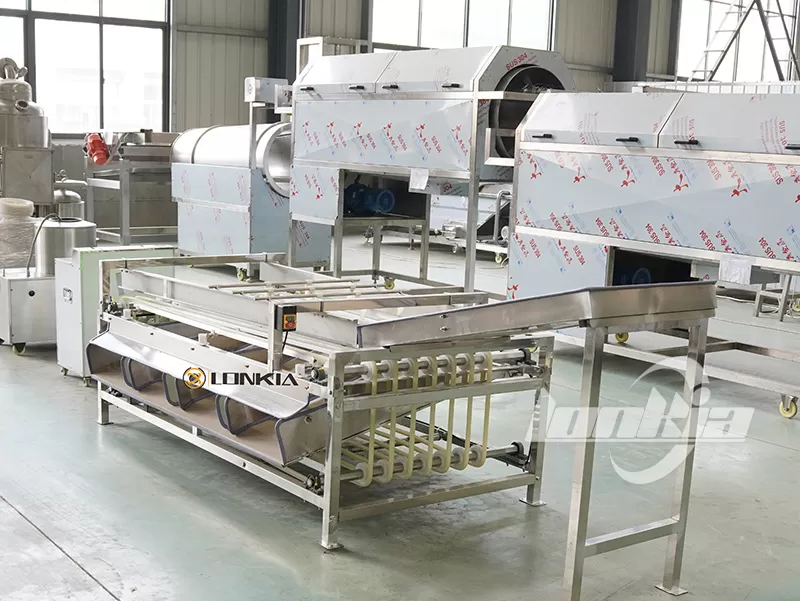
Installation Process for Automatic Fruit Grading Machines
Automatic fruit sorting and grading machines generally feature a modular design, primarily comprising:
- Feeding and lifting system
- Conveyor system
- Roller sorting system
- Manual inspection platform
- Discharge area
- Electrical control system
During installation, technicians first position the machine frame, then install the conveyor belt, rollers, gear reducers, and electrical control components, followed by leveling the entire machine.
The roller-type grading structure is currently one of the most stable grading methods in fruit and vegetable processing. It is characterized by smooth conveying, low damage rates, and the ability to perform continuous grading based on diameter. During operation, the spacing between rollers gradually changes, allowing products of different sizes to automatically fall into their corresponding outlets.
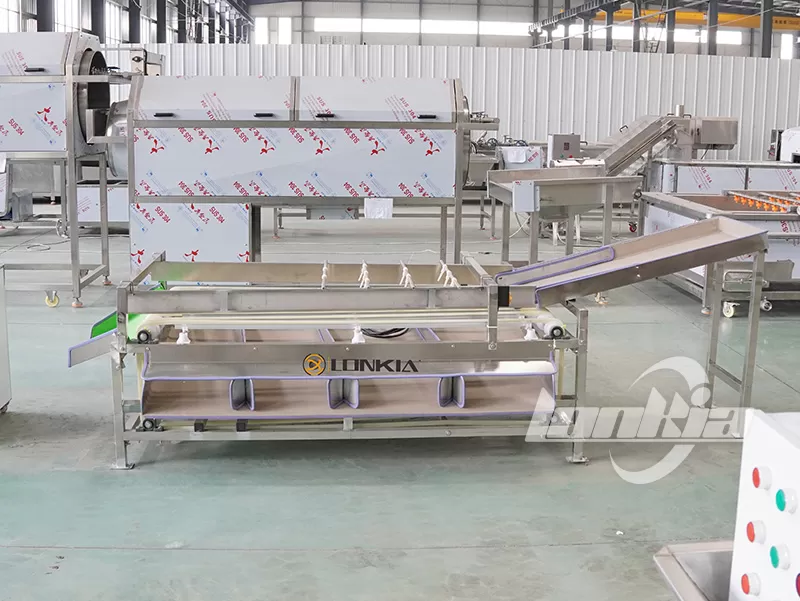
What Are the Key Inspection Points During Commissioning?
After the equipment is installed, comprehensive commissioning is required, primarily including:
Conveyor Speed Adjustment
Different fruits and vegetables have varying conveyor speed requirements. For example, tomatoes and bell peppers require a smoother conveying method, while potatoes prioritize processing efficiency.
Grading accuracy testing
Technicians will adjust the roller spacing according to customer requirements to achieve 4-tier, 6-tier, or even more levels of sorting.
Manual inspection area testing
The manual inspection station allows operators to remove damaged, unripe, or non-conforming products, thereby improving overall product quality. Some equipment also supports waste material conveying.
Electrical System Testing
Includes:
- Motor operation
- Emergency stop system
- Variable frequency drive (VFD)
- Voltage compatibility
- Single-phase/three-phase switching
Some customers also require equipment compatibility with solar power systems, so the commissioning phase must prioritize testing operational stability.
What Does Training for Vegetable Grading Machines Cover?
When using an automatic fruit sorting and grading machine for the first time, many customers' primary concern is not knowing how to operate it.
Therefore, professional training helps customers quickly master:
- Start-up and shutdown procedures
- Grading parameter adjustments
- Daily cleaning methods
- Replacement of wear-and-tear parts
- Lubrication and maintenance
- Troubleshooting
Proper training not only reduces equipment failure rates but also extends the equipment's service life. Studies show that when manual inspection is used in conjunction with the equipment, proper workstation design and training can effectively improve sorting accuracy.
Comprehensive After-sales Service helps Customers Start Production Faster
For overseas customers, reliable after-sales support is crucial. Lonkia typically provides customers with:
- Installation guidance
- Video commissioning support
- On-site training
- Spare parts list
- Operation and maintenance manual
- Electrical schematics
- One-year warranty service
Additionally, the equipment can be customized to meet specific processing requirements, including the number of grading stations, conveyor length, manual inspection areas, and material feeding/discharging methods, helping customers establish automated fruit and vegetable processing lines more efficiently.
Conclusion
A reliable vegetable grading machine requires not only precise grading capabilities but also comprehensive installation, commissioning, and training support. For fruit and vegetable processing plants, only when equipment operates stably can processing efficiency and product consistency be continuously improved.
As the demand for automated fruit and vegetable processing continues to grow, an increasing number of customers are focusing on comprehensive equipment solutions. Lonkia can provide integrated configuration solutions—covering feeding, grading, inspection, and training—tailored to different products and processing needs, helping customers establish stable and efficient fruit and vegetable processing workflows more quickly.