
As the ready-to-eat salad market continues to grow, food companies are placing greater emphasis on the cutting quality, cleaning effectiveness, continuous production capacity, and operational stability of fruit and vegetable processing machines. A well-configured set of fruit and vegetable processing equipment can enable continuous operations from raw materials to pre-packaging processing, improve product consistency, and provide a stable foundation for subsequent packaging and cold-chain transportation.
Identify the Products to Be Processed and Select the Appropriate Equipment Configuration
Different salad products have varying requirements for processing equipment. For leafy greens such as lettuce, spinach, and kale, the focus is on whether the washing process is gentle and whether dehydration is thorough. In contrast, root vegetables and fruits such as carrots, cucumbers, and red cabbage require different cutting methods, such as julienning, slicing, and dicing.
Therefore, before purchasing fruit and vegetable processing machine, the following key questions should be clarified:
- Which fruits and vegetables will be the primary raw materials?
- Should the finished product be julienned, diced, or sliced?
- Are multiple cutting specifications required?
- What is the planned hourly production volume?
Configuring equipment based on these requirements is more valuable than simply pursuing a high number of units, and it also reduces the cost of future adjustments.
Focus on Process Integration Across the Entire Production Line
For ready-to-eat salad production, the ability of equipment to operate continuously is more important than the performance of any single machine. A mature fruit and vegetable processing production line typically includes multiple stages, such as raw material sorting and conveying, cutting, soaking, vortex washing, and centrifugal dehydration. Maintaining stable integration between each piece of equipment reduces the need for manual transfer, improves production efficiency, and minimizes damage to raw materials during conveyance.
When selecting fruit and vegetable processing machine, focus on the following:
- Whether conveying is continuous and stable;
- Whether the processing capacities of each piece of equipment are compatible;
- Whether it is easy to add packaging equipment or other components later;
- Whether it is easy to clean and maintain on a daily basis.
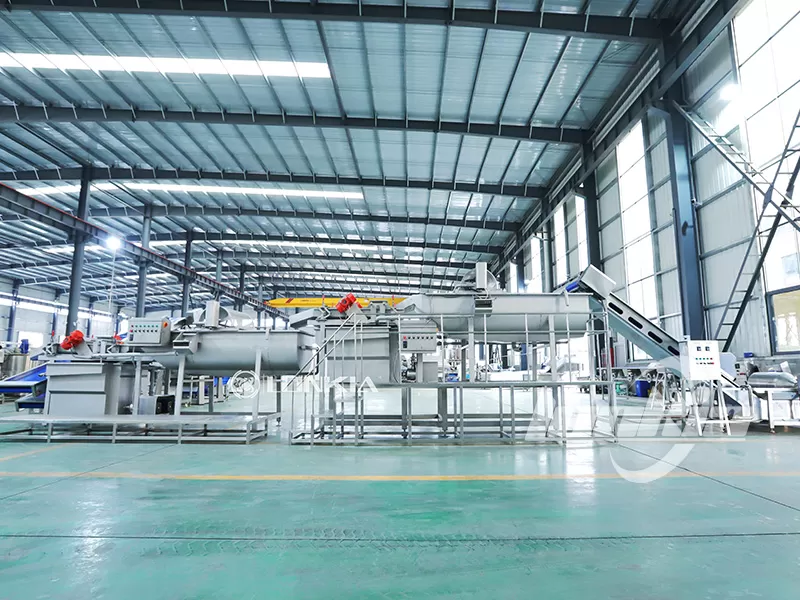
Cutting and Washing Quality Determine Product Quality
Since ready-to-eat salads are sold directly to consumers, uniformity in cutting and thoroughness in washing are particularly important.
High-quality vegetable cutters can produce uniformly sized strips, slices, or cubes, reducing breakage rates and ensuring a neater product appearance. Washing equipment typically combines swirling water flow with bubble circulation, allowing leafy vegetables to move naturally within the water stream to effectively remove soil and impurities while preserving leaf integrity as much as possible. Subsequent processing through automatic dehydration equipment effectively removes surface moisture, creating optimal conditions for subsequent packaging.
Equipment Materials and Maintenance Are Equally Important
Long-term, stable operation relies on a reliable equipment structure. It is recommended to prioritize fruit and vegetable processing equipment made of food-grade stainless steel, which is corrosion-resistant, easy to clean, and convenient to maintain—making it better suited for food processing environments.
Additionally, attention should be paid to whether the equipment features a modular design, whether blades are easy to replace, whether key components are easy to maintain, and whether after-sales service provides installation, commissioning, and technical support. Comprehensive service can effectively shorten the equipment's commissioning cycle and reduce long-term operating costs.
Choosing the Right Solution
The ideal fruit and vegetable processing machine for ready-to-eat salad production is not necessarily the one with the most features, but rather one that can be reasonably configured based on product types, process flows, and production requirements to achieve a stable, continuous, and efficient processing workflow.
Based on different fruit and vegetable raw materials and production processes, Lonkia provides fruit and vegetable processing solutions covering stages such as cutting, washing, and dehydration. These solutions help food processing companies establish more stable and efficient ready-to-eat salad production processes, providing reliable assurance for product quality and continuous production.