
For blueberry processing plants, fresh fruit packing centers, and juice producers, washing is a critical step before raw materials enter subsequent processing stages. As processing volumes increase, manual washing may face issues such as inconsistent processing speeds, uneven cleaning results, and high labor requirements. So, what are the respective advantages of manual washing and blueberry cleaners? How should companies choose the appropriate washing method?
Difference Between Manual Washing and Blueberry Cleaner
1. Manual Washing: Suitable for Flexible Processing, but Efficiency Is Limited
Manual washing is relatively simple to operate and allows for sorting and processing based on the actual condition of the blueberries. However, when raw material supply increases, manual operations are easily affected by the number of workers, their skill levels, and the pace of work, making it difficult to maintain a consistent processing speed over the long term.
Furthermore, if washing, draining, and transfer must be performed separately, this may increase the workload associated with coordinating these processes. For companies requiring continuous blueberry processing, a comprehensive assessment should be conducted to determine whether manual washing can meet production schedules.
2. Blueberry Cleaners: Suitable for Continuous, Batch Processing
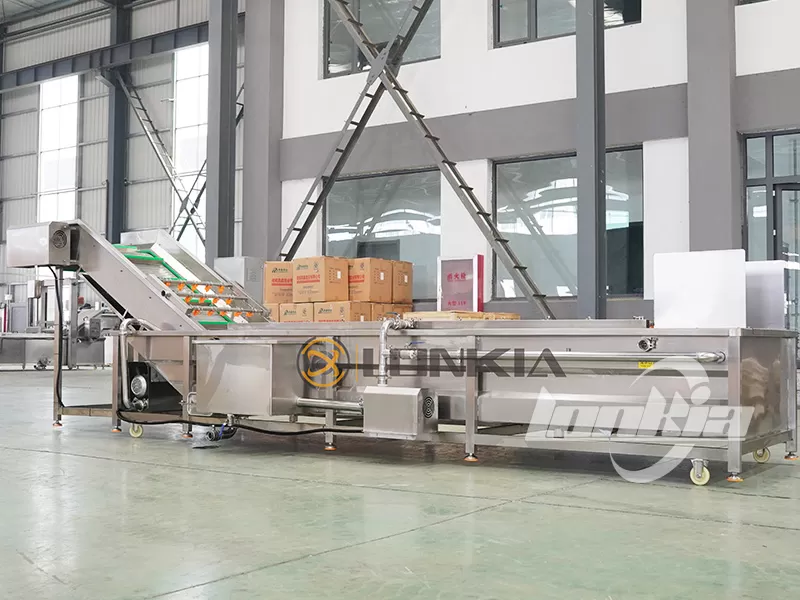
Blueberry cleaners combine functions such as bubble washing, spray rinsing, mesh belt conveying, and impurity filtration, enabling blueberries to be washed according to a preset process.
Taking LONKIA blueberry washing equipment as an example, the bubbling water flow helps loosen impurities adhering to the fruit's surface, the spray system further rinses the fruit, and the conveyor belt handles material movement. The specific cleaning effectiveness still depends on the condition of the blueberries, equipment parameters, and actual test results.
Which Factors Matter Most When Comparing the Two Methods?
Processing Capacity and Labor Requirements
The processing capacity of manual washing is closely tied to staffing levels, whereas mechanical washing can be adjusted based on equipment operating speed and feed rate.
Before purchasing, it is recommended to first determine how many kilograms of blueberries need to be processed per hour, and then compare the actual output of manual methods with the equipment's effective processing capacity. The blueberry cleaner's rated capacity does not necessarily equate to actual output under all operating conditions; it is also necessary to consider whether the feed, discharge, and subsequent processes are properly aligned.
Cleaning Consistency and Berry Protection
Blueberries are relatively fragile; during cleaning, it is essential to remove surface impurities while minimizing impact and friction as much as possible.
Mechanical washing does not mean operational controls can be overlooked. Excessive concentration of the feed, overly strong water flow, or improper conveyor connections can all increase the risk of fruit damage. Therefore, actual material testing should be conducted to verify cleaning effectiveness, fruit integrity, and surface condition.
Equipment Cost and Long-Term Operation
The initial investment for manual washing is typically lower, but for continuous processing, labor costs, processing time, and management expenses must be factored in.
Mechanical washing requires consideration of costs such as equipment procurement, installation, water and electricity consumption, maintenance, and operator training. It is recommended to calculate the unit processing cost based on daily processing volume and estimated operating time before determining whether the equipment investment aligns with production plans.
How to Choose the Right Blueberry Washing Solution?
Evaluate Your Production Requirements
First, confirm the daily raw material throughput, hourly production capacity targets, blueberry ripeness, and end use. Fresh fruit packaging, frozen processing, and juice production may have different requirements for subsequent processing steps; equipment configuration should be selected based on the actual production process.
Check the Machine Configuration
When purchasing a blueberry cleaner, pay close attention to the bubble system, spray nozzles, filtration system, conveyor speed adjustment methods, and the materials used for parts that come into contact with the product. Also, verify that the voltage, frequency, power rating, equipment dimensions, and installation requirements meet your facility's specifications.
Test Before Making a Final Decision
If there are significant variations in blueberry variety, ripeness, or surface condition, it is recommended to provide actual raw material for a test wash. By comparing the levels of impurities, fruit damage rates, and processing capacity before and after washing, you can more accurately determine whether the equipment meets production requirements.
Conclusion
For processing companies that need to handle large volumes of blueberries on an ongoing basis, blueberry cleaners can help improve processing efficiency and standardize the washing process; manual washing, on the other hand, offers certain advantages in terms of flexibility and initial investment. The final decision should be based on a comprehensive assessment of actual production capacity, fruit quality requirements, labor costs, and production line layout.
LONKIA can provide blueberry washing equipment solutions tailored to customers' processing capacities and process requirements. Clarifying the characteristics of the raw material, target output, and subsequent processing steps before purchasing will help you select equipment that best suits your production needs.