
In the fruit and vegetable processing industry, the washing stage directly impacts the efficiency of the entire production line and the quality of the final product. Selecting a bubble washer with the appropriate capacity not only affects cleaning effectiveness but also determines whether the production flow remains smooth. If the selection is inappropriate, it can easily lead to issues such as "equipment failing to keep up with the production line" or "waste of resources." This article will focus on the bubble cleaning machine to help you find the most suitable solution.
Why Selecting the Right Capacity for a Bubble Washer Is Critical?
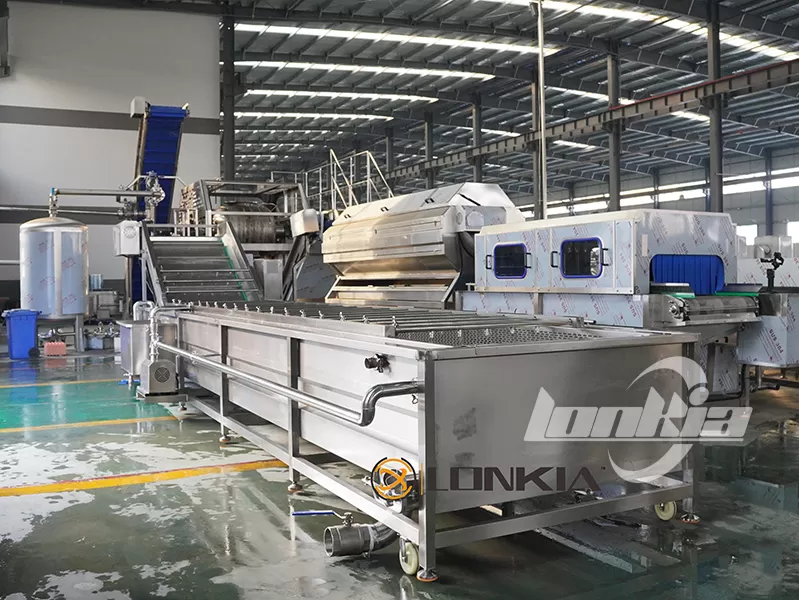
Bubble washers typically use a combination of bubble agitation and spray washing to tumble the produce in water and remove impurities continuously. This design dictates that the equipment must match the production line's pace; otherwise, the following issues may arise:
- Incomplete cleaning or product buildup
- Downtime or blockages in the downstream equipment
- Increased need for manual intervention
Therefore, capacity matching is one of the core criteria for equipment selection.
Common Capacity Ranges for Bubble Washing Machines
Based on industry equipment parameters, the processing capacity of bubble washers generally ranges from:
- 500–2000 kg/h (standard continuous models)
- 1500–4000 kg/h (medium to high-capacity production lines)
- Higher capacities available upon request (integrated with the entire production line)
👉 This means:
Larger equipment isn't necessarily better; it must precisely match your production needs.
How to Determine the Required Capacity of Your Bubble Washer?
1. Work Backward from Daily Processing Volume
First, clarify:
- How much raw material is processed daily
- How much needs to be processed per hour
For example:
Daily output of 10 tons → Approximately 1,250 kg per hour (calculated over 8 hours)
👉 Recommended selection: Equipment with ≥1,500 kg/h capacity
2. Match the Pace with Upstream and Downstream Equipment
Bubble cleaning machines are typically positioned:
- Before cutting
- Before grading
- Or at the beginning of the production line
If the fruit and vegetable washing equipment operates slower than the downstream equipment, it will reduce the overall line efficiency.
👉 Core Principle:
Washing equipment capacity ≥ Downstream equipment capacity
3. Adjust Capacity Based on Material Characteristics
Different materials have different washing time requirements:
- Leafy vegetables: Quick to wash, allowing for higher throughput
- Root vegetables: High soil content; require longer cleaning times
Bubble washers remove dirt through continuous agitation, but the dirtier the produce, the longer the dwell time required.
👉 Recommendation:
Higher soil content → Select equipment with higher capacity
4. Consideration of Expansion Capacity
Many customers overlook this point:
- Initial production volume is low
- Orders increase later
If equipment lacks capacity reserves, it will limit future growth.
👉 Recommendation:
It is more reasonable to choose equipment with a capacity 20%-30% higher than current demand.
How to Quickly Determine the Right Model for Your Plant?
When selecting a bubble washing machine model, follow these steps:
- Determine the hourly processing capacity (key metric)
- Identify the material type (determines the cleaning method)
- Determine if continuous production is required
- Determine if integration with the entire production line is required
If you are a food processing company, we recommend prioritizing equipment with adjustable bubble intensity and a recirculating water system to ensure stable processing of various materials.
Advantages of Lonkia Bubble Washers
As a food processing equipment manufacturer, lonkia prioritizes the following in its bubble washer designs:
- Adjustable cleaning intensity to accommodate various materials
- Continuous conveying structure to enhance production stability
- Multi-stage filtration system to ensure long-term operation
- Modular design for easy integration into production lines
In practical applications, this type of equipment not only improves cleaning efficiency but also significantly reduces the need for manual intervention.
Summary
Selecting a bubble washer with the appropriate capacity is fundamentally a process of "matching production needs," rather than simply choosing "bigger is better." Only by considering material type, production scale, and process flow can the equipment’s full value be realized.
If you are planning a production line, we recommend first determining the processing capacity and then working backward to determine the equipment configuration. This approach helps avoid costly adjustments later on.