
In food processing, the potato washer and peeler machine is a key piece of equipment for potato pre-processing. Selecting the appropriate equipment capacity not only affects production efficiency but also directly impacts operational stability and overall cost control. Many users tend to overlook this point when selecting equipment, resulting in machines that fail to meet actual needs. This article will help you make a more suitable choice by examining equipment structure and practical applications.
Defining Production Requirements Is the First Step
Before selecting a potato washer and peeler, you must first determine your actual processing needs, including:
- Daily processing volume (kg)
- Operating hours
- Whether continuous feeding is required
Basic capacity requirements can be calculated through simple calculations. For example:
If the daily processing volume is 2,400 kg and the operating hours are 8 hours, the equipment's capacity should be no less than 300 kg/h.
Based on this, we recommend adding a 20%–30% margin to ensure more stable equipment operation and avoid long-term full-load operation.
Equipment Structure Determines Actual Processing Capacity
Different models of potato washer and peeler machines have significant structural differences, which directly impact production performance.
The equipment typically consists of the following core components:
- Brush roller system: Peels the potatoes through rotational friction
- Spray system: Rinses away dirt and sand to improve cleanliness
- Drive system: Controls operating speed and stability
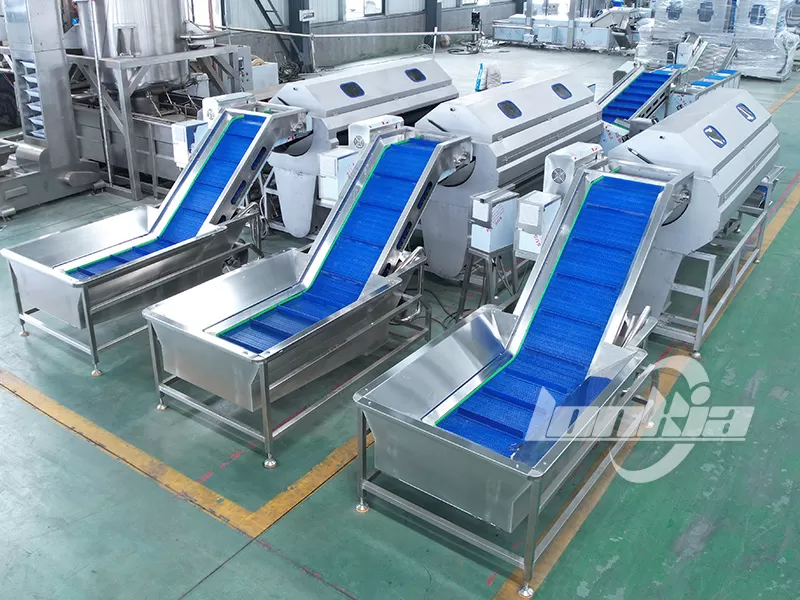
When the number of brush rollers increases and they are arranged more closely together, the contact area between the material and the brush rollers is larger, resulting in higher processing efficiency per unit of time. At the same time, a stable spray system can continuously remove impurities during the washing process, thereby enhancing overall processing capacity.
How to Select the Appropriate Capacity Range?
1. Match the Production Pace
The brush peeling machine's capacity must align with the entire production line. If the washing and peeling stage is too slow, it will affect subsequent cutting or processing steps; if it is too fast, it may lead to material backlogs. Therefore, capacity should be matched based on the overall line pace rather than selecting equipment in isolation.
2. Focus on Peeling Effectiveness and Waste
High capacity does not necessarily equate to high quality. If the brush roll speed is too high or friction is too intense, it may lead to increased raw material waste. Therefore, when selecting equipment, the following should be prioritized:
- Peeling uniformity
- Surface integrity
- Raw material waste ratio
A reasonable capacity should strike a balance between efficiency and quality.
3. Consider Equipment Operational Stability
Stable operation is more important than short-term high efficiency. High-quality equipment typically features:
- Consistent speed control
- Stable transmission structure
- Continuous feeding capability
These factors all influence actual production performance, not just theoretical values.
Core Differences Between Equipment with Different Production Capacities
From the equipment's perspective, increased production capacity is typically reflected in the following aspects:
- Increased brush roller length and quantity to expand the processing area
- Higher motor power to enhance operational capability
- Reinforced equipment structure to accommodate prolonged operation
Consequently, high-capacity equipment not only processes faster but also features a more stable structural design.
Analysis of Common Selection Pitfalls
During the actual procurement process, users often encounter the following issues:
- Focusing solely on price while ignoring production capacity: Low-cost equipment may fail to meet actual production needs, leading to increased costs down the line.
- Blindly choosing high-capacity equipment: Excessive capacity can result in resource waste and increased maintenance costs.
- Neglecting equipment compatibility: Equipment that is not compatible with the production line will reduce overall efficiency.
Recommendations for Optimizing Selection
To more efficiently select the appropriate potato washer and peeler machine, we recommend following these steps:
- Determine daily processing volume
- Convert to hourly capacity
- Add a reasonable margin
- Align with the production line's operational rhythm
- Evaluate peeling quality and wastage
Experienced equipment suppliers like Lonkia can typically provide tailored configuration solutions based on specific raw material characteristics and processing requirements, thereby ensuring both capacity and overall operational stability.
Conclusion
Selecting a potato washer and peeler machine with the appropriate capacity is, at its core, a comprehensive balancing act between production efficiency, equipment stability, and cost control. Only through reasonable planning that integrates actual needs, equipment structure, and production line rhythm can the true value of the equipment be realized.
If you are planning a production line or optimizing your existing equipment configuration, we recommend starting with capacity matching—this will be a crucial step toward improving overall processing efficiency.