
When it comes to preparing vegetables for freezing, drying, canning, or further processing, two popular methods dominate the food industry: blanching and steaming. While both techniques help preserve color, texture, and nutrients, they are not equally effective—especially at commercial production scale.
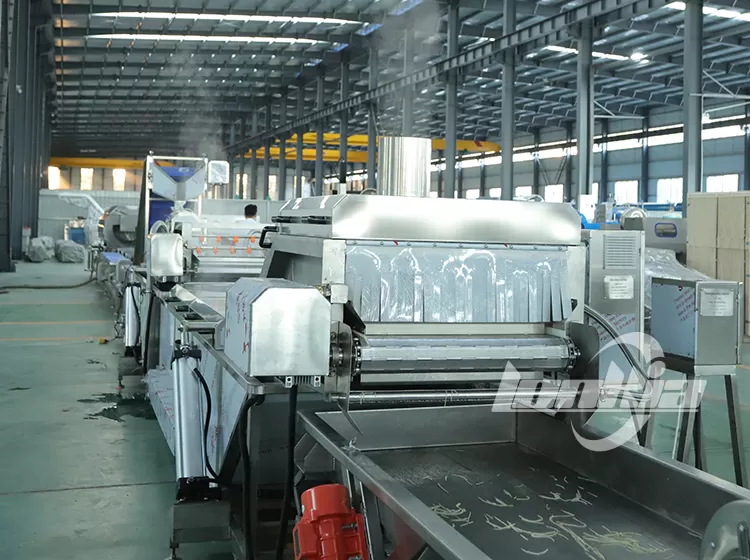
Food processors increasingly rely on industrial vegetable blanching machines rather than traditional steaming equipment. In this article, we explain the differences between blanching and steaming, and why modern factories prefer a blanching machine for consistent, high-quality results.
Blanching vs. Steaming: What’s the Difference?
✔ What Is Blanching?
Blanching involves briefly exposing vegetables to hot water (or steam in some systems) at controlled temperatures, followed immediately by rapid cooling.
Its primary purposes are:
Inactivating enzymes
Preserving natural color (especially green vegetables)
Softening the product for cutting or further processing
Improving texture
Extending shelf life
✔ What Is Steaming?
Steaming cooks vegetables using hot steam without submerging them in water.
It is commonly used for:
Ready-to-eat vegetables
Cooking small batches
Retaining nutrients for fresh consumption
While steaming works well in home kitchens and small restaurants, it is not ideal for large-scale industrial processing.
Why Blanching Outperforms Steaming in Industrial Applications
1. Better Enzyme Inactivation
Vegetables contain enzymes that cause:
Discoloration
Loss of flavor
Texture degradation
Reduced shelf life
Blanching is more effective at deactivating these enzymes because the heat transfer from boiling water is far more efficient than from steam.
Steaming, on the other hand, may not reach the core temperature needed to fully inactivate enzymes—especially in dense vegetables like carrots or potatoes.
2. Superior Color Retention
If you process vegetables such as:
Broccoli
Spinach
Peas
Green beans
Blanching delivers brighter and more stable color.
Boiling water transfers heat more evenly and quickly, preventing chlorophyll degradation. Steaming often results in dull or uneven color, especially in bulk production.
3. More Consistent Texture
Vegetable processors need predictable texture for:
Frozen products
Cutting and dicing
Canning
Vacuum-packed meals
Ready-to-cook foods
Blanching machines control:
Temperature
Water flow
Blanching duration
This gives every batch uniform softness and texture. Steaming equipment often produces inconsistent results, especially when vegetables vary in size or moisture content.
4. Faster Heat Transfer = Higher Efficiency
Water transfers heat 25 times faster than air or steam.
This means:
Faster blanching time
More efficient enzyme deactivation
Lower energy consumption per kilogram
Better throughput in industrial production
Steaming large volumes requires more time to achieve internal temperature targets.
5. Ideal for Large-Scale Continuous Production
Modern food factories need:
High output
Automation
Continuous feeding
Stable product quality
Industrial blanching machines are designed exactly for this. They offer:
Conveyor-based continuous processing
Precise temperature control
Automated cooling systems
Energy-saving recirculation technology
Steaming equipment is more suitable for small-batch cooking, not mass production.
Why a Blanching Machine Delivers the Best Results
A vegetable blanching machine provides industrial processors with key advantages:
✔ Uniform heating for every vegetable
Thanks to hot water circulation and adjustable conveyor speed.
✔ Perfect control over time and temperature
Ensuring every batch meets food safety and quality standards.
✔ Integrated cooling section
Rapidly locking in color, flavor, and texture.
✔ High processing capacity
Suitable for tons of vegetables per hour.
✔ Reduced labor and energy cost
Automation minimizes manual work and improves efficiency.
✔ Compatibility with production lines
Easy to connect with washing, cutting, peeling, and freezing equipment.
These features make blanching machines the preferred choice in modern processors of frozen vegetables, canned produce, ready meals, and dehydration plants.
Final Verdict: Blanching Wins for Industrial Processing
While steaming has its place in household and small-scale cooking, blanching is the superior method for industrial vegetable processing.
A dedicated blanching machine ensures:
Brighter color
Better enzyme control
Superior texture
Higher throughput
Consistent quality
Streamlined operations
For any food business aiming for high efficiency, stable quality, and long-term reliability, a vegetable blanching machine is clearly the best investment.