
In industrial vegetable processing, heat treatment plays a critical role in preserving quality, safety, and shelf life. Two commonly discussed methods are blanching and steaming. While they may appear similar on the surface, their purposes, results, and efficiency differ significantly—especially in large-scale production.
This article compares blanching vs steaming vegetables and explains why investing in a specialized vegetable blanching machine delivers better results for commercial food processors.
What Is Blanching?
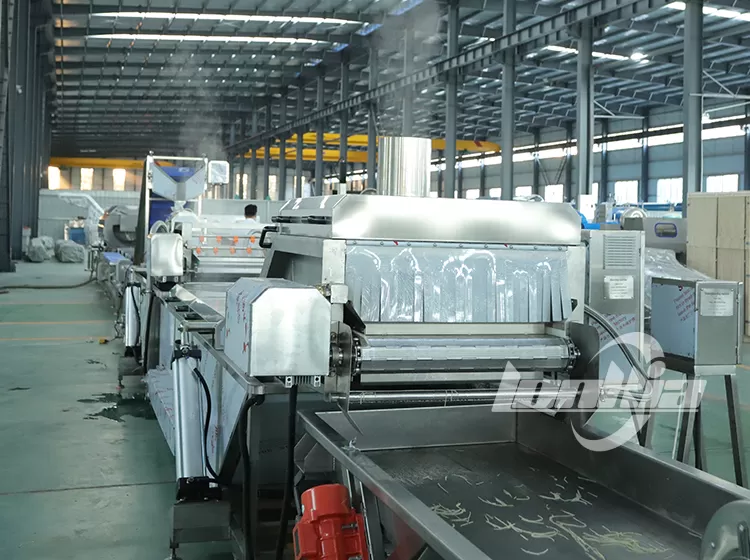
Blanching is a controlled pre-treatment process in which vegetables are exposed to hot water or steam for a short, precise time, followed by rapid cooling. The goal is not to cook, but to stabilize the product before further processing such as freezing, drying, or canning.
Main functions of blanching
Deactivate enzymes
Preserve natural color
Maintain firm texture
Reduce microbial load
Prepare vegetables for long-term storage
Blanching is a standard step in industrial vegetable processing lines.
What Is Steaming?
Steaming involves cooking vegetables using steam until they reach a desired level of doneness. It is commonly used in:
Restaurants
Catering kitchens
Ready-to-eat meal preparation
Steaming focuses on cooking for consumption, not on pre-processing for preservation.
Blanching vs Steaming: Key Differences
| Aspect | Blanching | Steaming |
|---|---|---|
| Primary purpose | Quality preservation | Cooking |
| Enzyme deactivation | Yes (critical function) | Limited |
| Texture control | Precise & consistent | Variable |
| Color retention | Excellent | Often inconsistent |
| Cooling step | Required | Usually not included |
| Industrial suitability | High | Limited |
| Automation potential | High | Low |
Why Blanching Outperforms Steaming in Industrial Processing
1. Effective Enzyme Deactivation
The main objective of vegetable blanching is to deactivate enzymes that cause:
Color fading
Texture softening
Nutrient loss
Steaming alone often fails to stop enzymatic activity completely, especially in thick or dense vegetables.
A vegetable blanching machine ensures precise temperature and time control, fully stabilizing the product.
2. Superior Color Preservation
Blanching locks in bright, natural colors:
Greens remain vibrant
Orange and yellow vegetables retain intensity
Browning reactions are minimized
Steaming may cause uneven heating, leading to dull or inconsistent color—unacceptable in commercial packaging.
3. Better Texture Control
Over-steaming results in soft, mushy vegetables. Blanching machines are designed to:
Deliver uniform heat
Prevent over-processing
Maintain firm, crisp texture
This is essential for frozen vegetables, diced products, and further mechanical processing.
4. Consistency at High Volume
Manual or batch steaming cannot deliver consistent results at scale. A specialized blanching machine offers:
Automated timing
Stable temperature control
Continuous or batch operation
This ensures every batch meets the same quality standards.
5. Integrated Cooling for Quality Lock-In
Unlike steaming, blanching includes immediate cooling, which:
Stops heat penetration
Prevents over-softening
Locks in texture and color
Industrial blanching machines are often paired with cooling or quenching systems for optimal results.
Why a Specialized Blanching Machine Is Worth the Investment
1. Higher Processing Efficiency
Automated blanching systems reduce:
Labor requirements
Processing time
Production bottlenecks
They are ideal for large-scale vegetable processing plants.
2. Lower Long-Term Operating Costs
Modern blanching machines are designed for:
Energy efficiency
Water recirculation
Reduced waste
This lowers operating costs compared to manual steaming methods.
3. Easy Integration into Production Lines
Vegetable blanching machines integrate seamlessly with:
Washing machines
Cutting and dicing equipment
Freezing, drying, or canning lines
This creates a fully automated, hygienic workflow.
Applications of Vegetable Blanching Machines
Blanching machines are widely used for:
Broccoli, spinach, green beans
Carrots, peas, corn
Leafy vegetables
Diced and sliced products
They support both hot water blanching and steam blanching, depending on product requirements.
Conclusion
While steaming has its place in cooking, it falls short in industrial vegetable processing. Blanching vs steaming vegetables is not simply a matter of preference—it’s a question of quality, consistency, and efficiency.
A specialized vegetable blanching machine delivers:
Reliable enzyme deactivation
Superior texture and color preservation
Consistent results at scale
Lower long-term production costs
For food processors focused on quality and efficiency, blanching machines are a smart and necessary investment.