
In modern food processing, preserving fresh color and natural texture is just as important as food safety and shelf life. This is why blanching has become a standard pre-treatment step in vegetable processing lines. The main objective of vegetable blanching is to protect texture, color, and overall product quality, while preparing vegetables for freezing, drying, canning, or further cooking.
With rising demand for consistent, large-scale production, a vegetable blanching machine delivers far better results than manual or small-batch methods. This article explains why texture and color preservation matter and how industrial blanching machines achieve superior performance.
What Is Vegetable Blanching?
Vegetable blanching is a controlled heat treatment process where vegetables are exposed to hot water or steam for a short time, followed by rapid cooling. Unlike full cooking, blanching is designed to:
Inactivate enzymes
Maintain natural color
Preserve crisp texture
Prepare vegetables for downstream processing
Blanching is widely used before freezing, dehydration, canning, and ready-to-eat food production.
The Main Objective of Vegetable Blanching: Texture & Color Preservation
1. Enzyme Deactivation to Protect Quality
Vegetables naturally contain enzymes that continue to function after harvest. If not controlled, these enzymes cause:
Color fading
Texture softening
Nutrient degradation
Blanching deactivates these enzymes, stabilizing vegetables and preventing quality loss during storage.
2. Color Retention for Visual Appeal
Bright, natural color is a key quality indicator for consumers. Proper blanching helps:
Lock in chlorophyll (green vegetables)
Stabilize carotenoids (carrots, peppers)
Prevent browning and discoloration
A well-designed vegetable blanching machine ensures uniform heating, resulting in consistent color across every batch.
3. Texture Control Without Overcooking
One of the biggest challenges in vegetable processing is maintaining texture. Over-blanching leads to mushy products, while under-blanching fails to protect quality.
Industrial blanching machines provide:
Precise temperature control
Accurate time regulation
Even heat distribution
This ensures vegetables remain firm, crisp, and structurally intact.
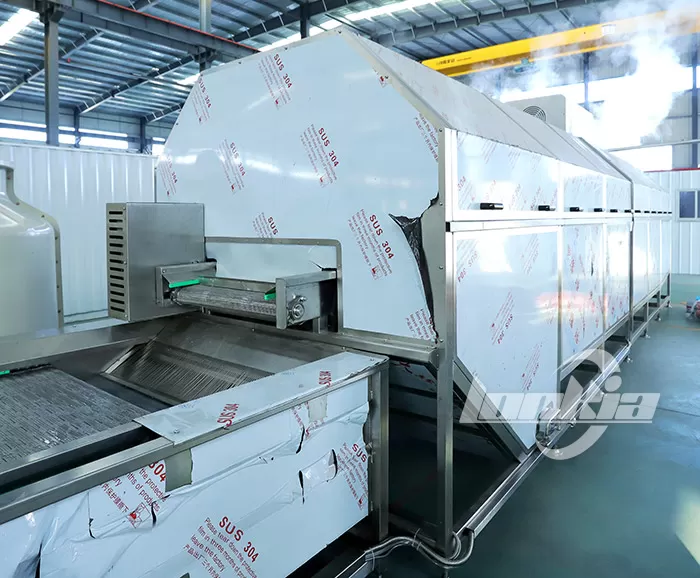
Why Use a Vegetable Blanching Machine Instead of Manual Blanching?
1. Consistency at Scale
Manual blanching cannot maintain consistent temperature and timing. A vegetable blanching machine guarantees:
Repeatable results
Uniform texture and color
Stable product quality across high volumes
This consistency is critical for commercial food brands.
2. Higher Processing Efficiency
Automated blanching systems significantly improve productivity:
Continuous operation
Reduced labor requirements
Faster throughput
This makes blanching machines ideal for large-scale food factories and central kitchens.
3. Energy and Water Efficiency
Modern blanching machines are designed to reduce operational costs through:
Heat recovery systems
Insulated blanching chambers
Controlled water circulation
This leads to lower energy consumption and reduced water waste.
4. Easy Integration into Processing Lines
Vegetable blanching machines can be seamlessly integrated with:
Washing machines
Cooling systems
Cutting and dicing machines
Freezing or drying lines
This creates a fully automated vegetable processing workflow.
Key Benefits of Using an Industrial Vegetable Blanching Machine
✔ Superior texture and color retention
✔ Reliable enzyme deactivation
✔ High production capacity
✔ Reduced labor costs
✔ Improved hygiene and food safety
✔ Consistent quality for downstream processing
These benefits make blanching machines essential for frozen vegetable plants, canned food production, dehydrated vegetable lines, and ready-to-eat food processing.
Applications of Vegetable Blanching Machines
Vegetable blanching machines are widely used for:
Broccoli, spinach, green beans
Carrots, peas, corn
Leafy vegetables
Root and diced vegetables
They are suitable for both steam blanching and hot water blanching, depending on product requirements.
Conclusion
The main objective of vegetable blanching is texture and color preservation, ensuring vegetables remain visually appealing, nutritionally stable, and structurally sound throughout processing and storage. A professional vegetable blanching machine provides the control, efficiency, and consistency required for modern food production.
For food processors aiming to deliver high-quality products at scale, investing in an industrial blanching system is not just an upgrade—it’s a necessity.