
In the fruit and vegetable processing industry, washing is a critical step that affects the quality of subsequent cutting, peeling, packaging, and processing. For processing plants that handle large volumes of fruits and vegetables daily, manual washing not only limits processing speed but also leads to inconsistent cleaning results across different batches. Fruit and vegetable washers use continuous conveying, recirculating water flow, bubble washing, and spray rinsing to ensure a more consistent cleaning process for raw materials within the equipment, thereby improving overall processing efficiency.
Why Do Traditional Cleaning Methods Often Become Production Bottlenecks?
Fruits, leafy vegetables, and root vegetables have different surface structures, and the types of soil, sand, and other impurities adhering to them also vary. For example, potatoes and carrots tend to have soil on their surfaces, while leafy vegetables such as lettuce and spinach are prone to harboring fine impurities between their leaves. Relying solely on manual rinsing not only requires significant labor but also makes it difficult to maintain consistent cleaning times and intensities across every batch of raw materials.
For processing plants operating on a continuous production basis, the real challenge lies in ensuring consistent and uniform cleaning.
How Does the Fruit and Vegetable Washer Improve Cleaning Efficiency?
1. Bubbled Water Flow Increases Contact Between Produce and Water
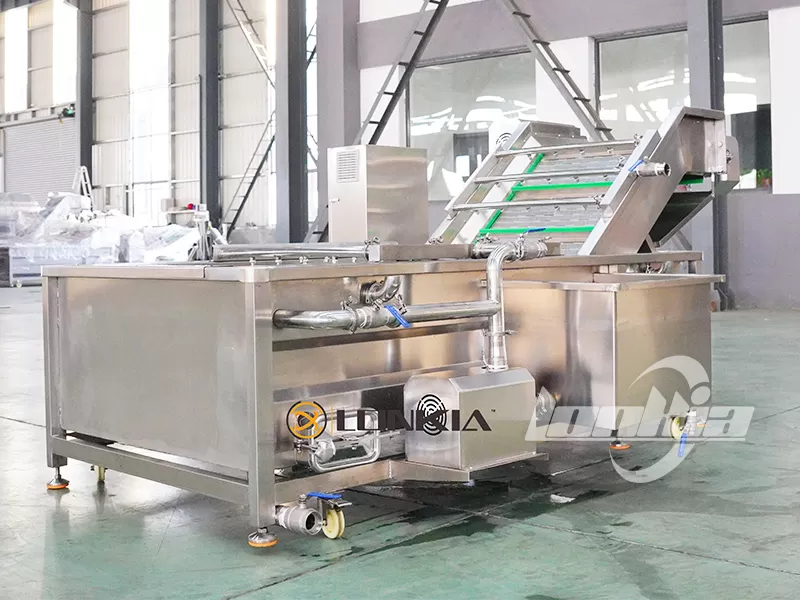
Bubble washing is a common method used in fruit and vegetable washing equipment. The fruit and vegetable washer uses a bubbling mechanism to create a churning water flow, ensuring that fruits and vegetables come into full contact with the water and move freely within it. The water flow generated as the bubbles burst acts on the product's surface and the gaps between leaves, helping to loosen adhered soil and impurities.
For leafy greens such as lettuce, spinach, and cilantro, properly controlling the bubble intensity and conveyor speed can improve cleaning efficiency while maintaining product integrity.
2. Spray System for Further Rinsing
Relying solely on soaking or bubble washing may not be sufficient for some firmly adhered impurities. Therefore, the equipment can incorporate a spray stage during the conveying and lifting processes to further rinse the produce.
LONKIA's fruit and vegetable washer configures appropriate washing methods based on different raw materials, combining bubble washing with spraying to create a continuous processing flow from the time the produce enters the equipment until it exits.
3. Continuous Conveyance Reduces Manual Waiting Time
Automated conveyance is also a key factor in improving efficiency. Once raw materials enter the washing tank, they are continuously moved forward by the conveyor system, undergo processing within the designated washing zone, and then proceed directly to the next process step.
This design is particularly well-suited for salad processing, pre-cut vegetables, frozen vegetables, and other continuous processing lines. It reduces manual handling and repetitive loading/unloading, making it easier to integrate the washing stage with downstream equipment.
How to Choose the Right Washing Equipment?
Improving efficiency does not simply mean increasing water flow velocity or shortening washing time. When purchasing fruit and vegetable washer, you should first determine the raw materials to be processed, the hourly throughput, the degree of contamination, and whether the product is prone to damage, and then select a washing solution—such as bubble, spray, brush, or a combination of these methods.
For example, root and tuber vegetables typically require stronger surface cleaning capabilities, while leafy greens and certain delicate fruits are better suited for gentle water flow treatment. Adjusting the cleaning intensity and conveyor speed based on the actual product is often more important than simply pursuing higher equipment specifications.
Summary
A suitable fruit and vegetable washer not only reduces the burden of manual washing but, more importantly, ensures greater stability in washing time, conveyor operation, and processing methods. By properly configuring the washing system and adjusting equipment parameters according to different fruits and vegetables, the system can provide more consistent raw materials for subsequent cutting, peeling, sorting, and packaging.
If you are planning a fruit and vegetable processing line, LONKIA can provide corresponding washing equipment configurations based on raw material types, processing capacity, and production processes, helping customers select the appropriate washing solution based on their actual production needs.