
When building a peeled garlic processing plant, selecting the right equipment is only the first step. For continuous garlic processing, a well-designed plant layout is equally critical to ensuring smooth material flow, maximizing equipment capacity, and facilitating future cleaning and maintenance. A well-designed layout should be planned around raw material intake, continuous processing, finished product output, and operator access, avoiding excessive distances between equipment or cross-conveyance.
Determining the Overall Garlic Processing Flow
Arranging Equipment According to Processing Sequence
A typical peeled garlic processing flow can be laid out as follows:
Raw garlic → Washing → Clove crushing/separation → Grading → Pneumatic peeling → Peeling and separation → Inspection and sorting → Drying → Weighing and packaging
This unidirectional flow minimizes cross-contamination between raw materials and finished products and facilitates the connection of conveyors between equipment. LONKIA's pneumatic peeling system can process crushed garlic cloves without soaking and can be configured for different garlic varieties and sizes.
Upper- and Lower-Stream Equipment Capacities Must Be Aligned
When designing a peeled garlic processing plant, one must not focus solely on the peeling machine's rated capacity. If the upstream clove separation and grading capacities are insufficient, the peeling machine will be unable to receive a continuous feed; if the downstream sorting, drying, or packaging speeds are too slow, material backlogs will occur. Therefore, processing capacity for each stage should be calculated in reverse, based on the target finished product output.
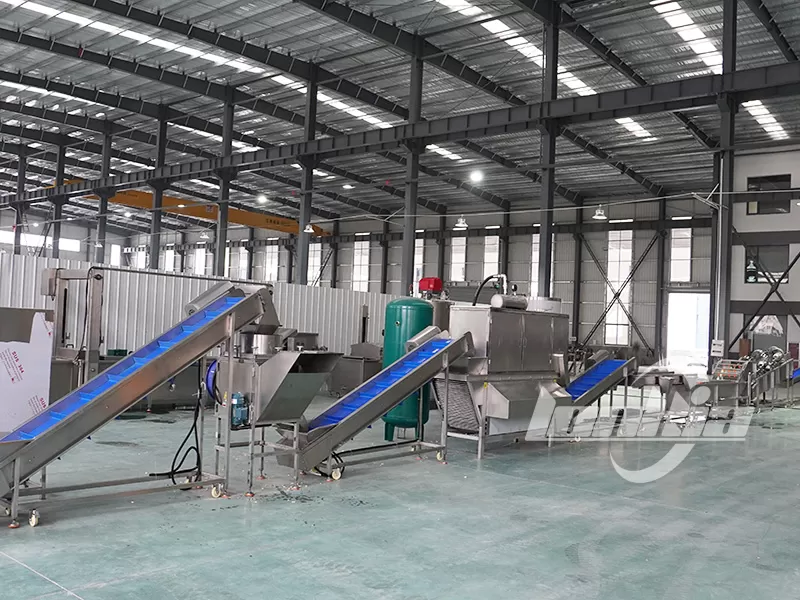
What Key Factors Should Be Considered in Plant Layout?
Allow for Equipment Operation and Maintenance Space
Equipment should not simply be arranged "as tightly as possible." Reserve sufficient space for operation, inspection, and maintenance around the washing machine, clove separator, peeler, and conveyor systems—especially around components that require disassembly for cleaning.
LONKIA production lines feature a modular design, with some components being removable, which facilitates daily cleaning and maintenance.
Maintain a Clear Material Flow Direction
It is best to establish a clear material flow path from the raw material inlet to the finished product outlet. Conveyor length, turning points, and discharge heights should all be determined during the equipment layout phase to avoid unnecessary manual handling later on.
Determine Back-End Configuration Based on the Final Product
If producing fresh peeled garlic, prioritize sorting, washing, dehydration, and packaging after peeling; if garlic slices, garlic paste, or garlic powder are also to be produced, reserve corresponding equipment interfaces after the peeling section. A peeled garlic processing plant can be combined with downstream processing equipment according to different product requirements to form a continuous production solution.
What Should Be Provided to Equipment Suppliers Before Plant Construction?
Before finalizing the peeled garlic processing plant layout, it is recommended to provide the target output, raw material specifications, garlic clove size, final product, factory dimensions (length, width, and height), electrical requirements, and the expected level of automation. Suppliers can use this information to determine the number of equipment units, conveying directions, and overall dimensions.
For customers requiring continuous production, LONKIA can configure the entire production line based on actual process and capacity requirements, helping customers achieve a reasonable balance between equipment performance, space utilization, and operational efficiency.