
In the garlic processing workflow, peeling is a critical step that affects the efficiency of subsequent processing and product quality. For processing companies that need to handle large volumes of garlic cloves continuously, simply purchasing a standalone garlic peeling machine does not fully address production challenges. What is even more important is ensuring that the peeling equipment is properly integrated with the upstream and downstream processing equipment to create a stable processing workflow.
The Role of the Garlic Peeling Machine in the Garlic Processing Line
A complete garlic processing cycle typically involves steps such as separating cloves, peeling, sorting, washing, drying, and further processing. Among these, the peeling equipment is primarily responsible for quickly separating the outer skin from the garlic cloves, providing clean, intact garlic cloves as raw material for subsequent processing.
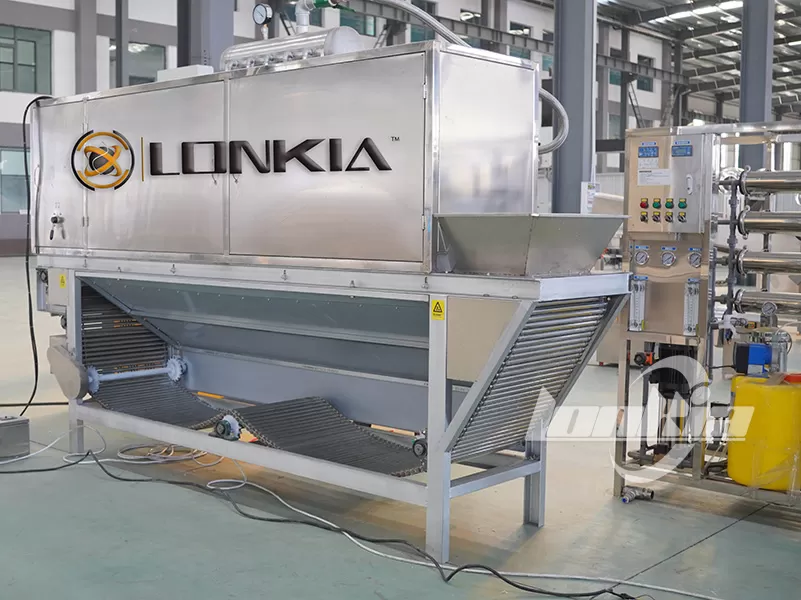
The Lonkia garlic peeling machine employs a pneumatic peeling principle, using air pressure to separate the garlic cloves from their skins. This non-abrasive peeling method minimizes compression and impact on the garlic cloves. The machine has a processing capacity of 100–150 kg/h and supports adjustable air pressure and peeling time, allowing operators to tailor parameters to different garlic clove sizes.
How to Connect Upstream Equipment?
1. Separate the Garlic into Cloves
If whole garlic heads are being processed, they typically need to first pass through a garlic clove separator to separate the heads into individual cloves before entering the Garlic Peeling Machine.
The processing capacity of the upstream clove-separating equipment must match that of the peeling machine. If the clove-separation speed is significantly lower than the garlic peeling machine's processing capacity, the peeling machine will be unable to maintain a continuous feed; conversely, this may lead to material backlogs in the upstream section.
Therefore, when designing a production line, the hourly capacity of each piece of equipment should be calculated uniformly based on the actual raw material throughput.
2. Maintain a Steady Feed
The performance of the electric garlic peeler depends not only on the equipment itself but also on the uniformity of the feed. During continuous production, avoid feeding large quantities of garlic cloves at once, as this can disrupt the processing rhythm inside the machine.
Proper conveying and feeding methods ensure that garlic cloves enter the peeling machine continuously and evenly, thereby improving operational stability.
How to Integrate with Downstream Equipment After Peeling?
1. Sorting and Washing After Peeling
Once peeling is complete, manual sorting or appropriate conveying stages can be set up according to final product requirements to remove residual garlic skins and non-conforming cloves.
If the product requires further processing, the peeled cloves can be fed into washing equipment, followed by dehydration or air drying, to prepare the raw material for subsequent processing.
2. Configure Downstream Equipment Based on the Final Product
Peeled garlic cloves can be used for a variety of processing applications, such as pre-packaged garlic cloves, garlic paste, and garlic powder.
Therefore, the garlic peeling production line does not need to use a fixed, identical combination of equipment; instead, subsequent processes should be determined based on the final product. For example, when producing pre-packaged garlic cloves, the focus should be on washing, drying, and packaging; when producing garlic powder, additional equipment such as slicing, drying, and grinding machines will be required.
How to Ensure Stable Operation of the Entire Garlic Production Line?
When planning the garlic peeling machine, it is recommended to focus on three key aspects: the capacity of the upstream clove-separating equipment, the actual processing capacity of the peeling machine, and the capacity of the downstream washing or processing equipment.
If the processing capacity at any one stage is significantly lower, it may become a bottleneck for the entire production line. In addition, the appropriate air pressure and peeling time should be tested based on the size of the garlic cloves. This equipment supports parameter adjustment, allowing for optimized peeling results for garlic cloves of different sizes.
Conclusion
The key to properly integrating a garlic peeling machine lies not in simply adding the peeling equipment to the production line, but in appropriately matching upstream and downstream equipment based on raw material throughput, garlic clove specifications, peeling requirements, and the final product. Through the correct combination of equipment and parameter settings, the peeling process can be made more stable, providing continuous and consistent raw materials for subsequent garlic processing.